Open Angle Post Logo
News Without the Noise

Facts over outrage. Clarity over certainty.

Somaliland's Recognition: Balancing Geopolitics, Regional Stability, and the Imperative for Somali Dialogue
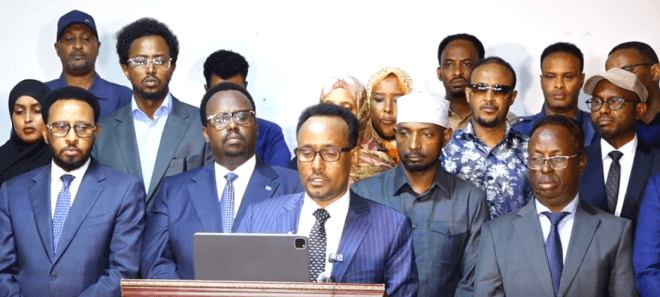
Image from:hiiraan.comhiiraan.com

Somaliland's Recognition: Balancing Geopolitics, Regional Stability, and the Imperative for Somali Dialogue

Confidence:
●●●●○
Disagreement:
institutional
Values Alignment:
●●●●○8/10ℹ️

Entities Mentioned

Key Takeaways

  • 1Israel's recognition of Somaliland highlights the complex interplay between national sovereignty, international recognition, and geopolitical strategy in the Horn of Africa.
  • 2The responses to Israel's decision reveal a global divergence in perspectives on self-determination, territorial integrity, and the role of external actors in internal conflicts.
  • 3The threat from Houthi rebels underscores the interconnectedness of regional conflicts and the potential for external actors to exacerbate existing tensions.
  • 4The situation exposes the limitations of international law and the challenges of achieving consensus on issues of statehood and recognition in a fragmented world order.
  • 5The controversy surrounding Israel's recognition reflects a broader pattern of competing interests and values that shape international relations and diplomatic maneuvering.

What Happened

  • Israel officially recognized Somaliland as an independent state, a move announced by Prime Minister Benjamin Netanyahu, marking the first such recognition from a UN member state since Somaliland declared independence from Somalia in 1991. This decision has been met with mixed reactions, with Somaliland's president celebrating it as a historic moment, while Somalia has condemned it as an attack on its sovereignty.
  • The recognition has drawn criticism from various international bodies, including the African Union, Egypt, Turkey, the Gulf Cooperation Council, and the Organisation of Islamic Cooperation, all emphasizing the importance of respecting Somalia's territorial integrity. The European Union has also insisted on the need to uphold Somalia's sovereignty, reflecting a widespread concern about the potential destabilizing effects of recognizing a breakaway region.
  • The Houthi rebels in Yemen have threatened to consider any Israeli presence in Somaliland as a military target, further complicating the geopolitical landscape. This threat underscores the interconnectedness of regional conflicts and the potential for escalation, particularly given the strategic importance of the Red Sea and the Gulf of Aden.
  • In the United States, Israel's recognition of Somaliland has become entangled in domestic political debates, with some Republican factions using it to fuel anti-Somali sentiment. This development highlights the complex ways in which international events can be appropriated and manipulated for partisan purposes within national contexts.
  • Somaliland, a semi-desert territory on the Gulf of Aden coast, declared independence from Somalia in 1991 following the overthrow of Somali military dictator Siad Barre, and has since established its own political system, government institutions, police force, and currency, though without widespread international recognition until Israel's recent move.

Opposite Sides

Left Wing Perspective
Left-leaning perspectives view Israel's recognition of Somaliland with suspicion, seeing it as a move driven by strategic self-interest and potentially undermining the sovereignty of Somalia. They emphasize the importance of international solidarity with Somalia and caution against actions that could exacerbate existing conflicts or create new forms of dependency. They also highlight the potential for this move to be exploited by right-wing factions to further anti-immigrant agendas.
Right Wing Perspective
Right-leaning perspectives may see Israel's recognition of Somaliland as a pragmatic move that strengthens Israel's geopolitical position in the Red Sea region and provides a potential ally in the fight against terrorism. They emphasize the importance of supporting stable and democratic entities like Somaliland, even if they lack widespread international recognition. They may also view this as an opportunity to counter Iranian influence in the region.
The Unspoken Tension
The unspoken tension lies in the competing principles of national sovereignty versus self-determination, and the selective application of these principles based on geopolitical interests. Both sides tend to prioritize their own strategic goals and ideological commitments over a consistent application of international law and norms. Neither side fully acknowledges the potential for unintended consequences and the complex dynamics of local politics.
⚖️Plausible Solutions (Radical Centrist Approach)
This isn't either/or—it's both/and. To bridge these divides: 1. Establish a UN-led mediation process to facilitate dialogue between Somalia and Somaliland, focusing on practical cooperation and mutual recognition of respective governance structures. 2. Implement a regional security framework that addresses the concerns of all stakeholders, including Somalia, Somaliland, and neighboring countries, to prevent the exploitation of the situation by external actors like the Houthi rebels. 3. Promote economic development and investment in both Somalia and Somaliland, focusing on projects that benefit local communities and foster greater integration. 4. Develop a clear and consistent set of criteria for recognizing new states, based on principles of self-determination, human rights, and democratic governance, to avoid the perception of double standards and selective application.

Where the Disagreement Really Lives

Institutional Disagreement

The disagreement is about how systems, institutions, or structures should function—conflicts over governance, processes, or institutional design.

What We Know / What We Don't

Confidence:
●●●●○

What We Know

Israel has recognized Somaliland as an independent state, a move that has been celebrated by Somaliland but condemned by Somalia and several international organizations, including the African Union and the EU. The Houthi rebels in Yemen have threatened to consider any Israeli presence in Somaliland as a military target. Somaliland declared independence from Somalia in 1991 and has since operated as a self-governing entity with its own institutions and currency. The US defended Israel's decision at an emergency UN Security Council session.
?

What We Don't Know

The long-term consequences of Israel's recognition on regional stability and the future of Somalia-Somaliland relations remain uncertain. The extent to which other countries will follow suit in recognizing Somaliland is also unknown. The specific details of any potential security or economic agreements between Israel and Somaliland have not been disclosed.

Plausible Paths Forward

1
If Somaliland gains wider international recognition:
If other nations follow Israel's lead and recognize Somaliland, it could solidify Somaliland's status as an independent state and lead to increased economic investment and diplomatic engagement. This could also encourage other separatist movements around the world, potentially destabilizing existing nation-states and altering the global political map.
2
If Conflict escalates between Somalia and Somaliland:
If tensions between Somalia and Somaliland escalate, it could lead to armed conflict and further destabilize the region. This could also draw in external actors, such as neighboring countries or international powers, exacerbating the conflict and creating a humanitarian crisis.
3
If Israel establishes a military presence in Somaliland:
If Israel establishes a military presence in Somaliland, as threatened by the Houthi rebels, it could provoke a wider regional conflict and destabilize the Red Sea region. This could also lead to increased terrorist activity and further complicate the already complex geopolitical landscape.

The Quiet Take

💭

The situation highlights the inherent instability of post-colonial borders in Africa and the challenges of reconciling competing claims of national sovereignty and self-determination. The international community's reluctance to recognize Somaliland reflects a broader fear of encouraging secessionist movements and undermining the existing state system. However, the failure to address the underlying grievances and aspirations of marginalized communities can lead to prolonged conflict and instability. A more nuanced approach is needed that balances the principles of territorial integrity with the rights of self-determination and democratic governance.

What Would Change Our View

Conditions That Would Shift Our Assessment

1If Somalia and Somaliland were to engage in successful negotiations leading to a mutually agreed-upon resolution of their status, it would significantly alter the analysis.
2Evidence of widespread popular support within Somalia for recognizing Somaliland's independence would also shift the perspective.
3Concrete details about the nature and scope of any agreements between Israel and Somaliland would also be crucial.

Source Political Spectrum

Loading spectrum data...

Explore coverage from 52 different publications

Comments

Loading comments...